An unexpected hero: how Virginia’s endangered shark species help protect our climate
Written by Paige Epler
For some people, the idea of sharks living abundantly in Virginia’s coastal waters might be a frightening thought. But real sharks aren’t the man-eating monsters of pop culture – in fact, Virginian beach-goers are vastly more likely to be struck by lightning than attacked by sharks, according to the Chesapeake Bay Foundation. Virginia’s most common sharks include the sandbar shark, smooth dogfish, and Atlantic sharpnose shark, but some, like the dusky shark, are in sharp decline due to overfishing. Even the sandbar shark, Virginia’s most commonly sighted shark species, is threatened by overfishing and is currently classified by the International Union for Conservation of Nature (IUCN) as endangered.
But preserving Virginia’s shark population isn’t just a courtesy to the ecosystem. Sharks play a vital role in maintaining a healthy ocean, and their decline has far-reaching consequences for Virginia’s climate – and thus our health, infrastructure, and economy.
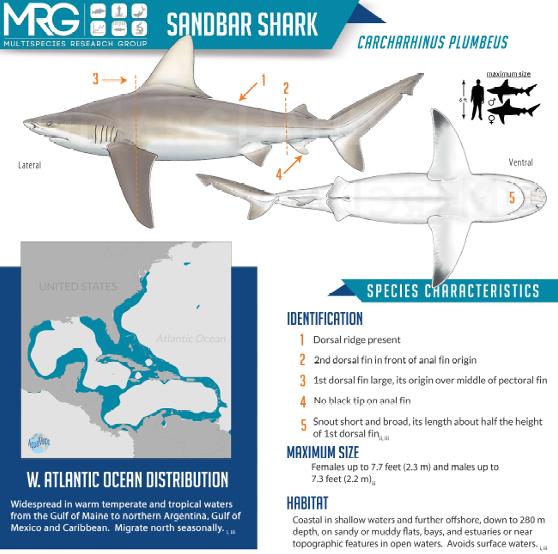
Identification chart for the sandbar shark, Virginia’s most common large shark species. Source: Virginia Institute of Marine Science
Rising temperatures
The Virginia Climate Assessment cites rising temperatures, caused by climate change, as a critical threat to healthcare, labor, and agriculture. One of Virginia’s greatest defenses against climate change exists off its coast: seagrass meadows. Rich in marine plants, these ecosystems capture carbon dioxide over twice as effectively as forests on land, expertly combating the effects of carbon emissions on the atmosphere. The preservation of seagrass meadows off Virginia’s coast is a crucial element in our fight against the rising frequency and intensity of the heat-related hazards produced by climate change.
Sharks play an extremely important role in preserving those seagrass meadows. As predators at the top of the oceanic food chain, they regulate the populations of other wildlife in marine ecosystems – both directly and indirectly. The very presence of sharks in seagrass meadows influences grazers, such as Virginia’s many species of sea turtles, to travel more frequently instead of staying in one area and overfeeding on plants. By giving seagrass meadows the opportunity to regrow, allowing them to continue capturing and storing carbon, Virginia’s sharks help to protect us from climate change and the rising heat it brings.
Sea levels and floods
Further consequences of climate change, cited in the Virginia Climate Assessment, include a rise in sea levels and flooding. Virginia is facing a higher rate of rising sea levels than the global average, resulting in threats to our housing, transportation, and agriculture – and ultimately both our well-being and our economy – due to coastal floods. Once again, Virginia’s infrastructure has a surprising guardian in the form of its sharks and their protection of seagrass meadows, shielding carbon-capturing plants from overgrazing – and us from carbon emissions and global warming.
But that’s not the only role sharks play in protecting us from rising sea levels and coastal flooding. The effects of global warming caused by climate change, such as rising sea levels and decreasing water quality, are being exacerbated by a decline in oxygen concentrations in our oceans. About half of Earth’s oxygen comes from microscopic phytoplankton: plants, algae, bacteria that photosynthesize, producing oxygen in the process. Sharks help to support Earth’s population of phytoplankton by swimming between different layers of the ocean, dredging up nutrients from the deep to sustain phytoplankton on the surface. Sharks’ role at the top of the ocean food chain also helps keep its ecosystem in balance, preventing the overabundance of plankton-eating wildlife and the depletion of phytoplankton.
The sharks in Virginia’s waters serve vital, complex functions in the environment that, in turn, protect humans from both health risks and economic losses. As such, the decline in Virginia’s shark populations due to overfishing ultimately threatens humans as well. In order to mitigate climate change hazards in Virginia, measures can be taken to protect our sharks.
What can we do?
Everyone, from policy-makers to educators to the general public (yes, you too!) can take part in measures to help protect Virginia’s sharks:
Education – teaching people why we need to save sharks – is crucial. Sharing resources like this blog post and the sources it cites can raise awareness of the role Virginia’s sharks play in protecting its climate.
Sharing information with policy-makers about the role of Virginia’s sharks in protecting our climate can help to inform policies that protect sharks in our waters and signal a strong public opinion on the topic.
Volunteering with Virginia’s wildlife preservation organizations can have a great impact as well. The Virginia Aquarium & Marine Science Center and the Virginia Institute of Marine Science both have ongoing efforts in shark conservation.
Ultimately, the actions we take to preserve shark populations in Virginia’s coastal waters can help mitigate the negative effects of climate change on our health, infrastructure, and economy. From shielding seagrass meadows to stirring up nutrients for oxygen-producing plankton, Virginia’s endangered sharks help our climate in many ways, and it’s up to us to protect our sharks – and in doing so, protect ourselves.
Authors

Paige Epler, MSE
Paige Laura Epler is a biomedical engineer and researcher specializing in translational cell and tissue engineering. She earned her Master of Science in Engineering degree in biomedical engineering from Johns Hopkins University in 2022, and is the founder and director of the independent Save the Sharks conservation advocacy campaign.