Written by Dinesh Neupane and Dr. Lucas Henneman
If you have ever watched dark clouds arrive after a stretch of hazy weather, you may have wondered whether the coming rain will finally clear the air. It seems intuitive. Rain falls, the haze disappears, and the air feels cleaner afterward. But when that haze comes from wildfire smoke, the relationship between rain and air quality is more complicated than it may appear.
This question is becoming increasingly important. Over the past several decades, air quality across the United States has improved substantially as emissions from sources such as power plants and vehicles have declined. Yet wildfire smoke is becoming a growing source of particulate matter pollution and threatens some of those hard-earned improvements. Our research at George Mason University asks a simple question with important implications: How effectively does rainfall remove particulate matter from the atmosphere, and does it work the same way during wildfire smoke events?
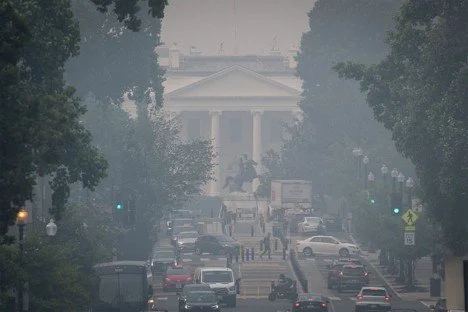
A smokey haze in Washington DC area June 8, 2023. Source: WTOP/Alejandro Alvarez
What happens when it rains?
Particulate matter, or PM, refers to tiny particles suspended in the air. We studied two common sizes of PM: PM2.5, particles smaller than 2.5 micrometers, and PM10, particles smaller than 10 micrometers. When rain falls, droplets can collect these airborne particles and carry them toward the ground. Scientists call this process wet scavenging. Particles can collide directly with raindrops, be intercepted as they move around a drop, or reach the drop through very small random motions. These processes make precipitation one of the atmosphere's natural mechanisms for removing particulate pollution. But not every particle behaves the same way. Size, chemical composition, the amount of pollution already in the air, and rainfall intensity can all influence how much material is removed.
More rain generally means more particles are removed
One of the clearest findings was that precipitation was associated with reductions in both PM2.5 and PM10. The amount removed increased as rainfall became heavier. At rainfall rates near 4 millimeters per hour, our estimates indicated roughly a 10 percent reduction in PM2.5 and a 17 percent reduction in PM10. At rainfall rates near 15 millimeters per hour, estimated reductions reached about 18 percent for PM2.5 and 25 percent for PM10. There was an interesting twist. The amount removed per additional millimeter of rain was strongest at relatively low rainfall rates, around 1 to 3 millimeters per hour. Beyond that range, each extra millimeter of rain produced a smaller incremental benefit. Even so, because more rain was falling overall, the total amount of particulate matter removed continued to increase.
In other words, a heavier rainstorm can remove more pollution in total, even though each additional millimeter of rainfall becomes somewhat less effective than the first few.
Bigger particles are easier for rain to remove
We also found a clear difference between particle sizes. Across rainfall intensities, initial pollution levels, and wildfire-smoke conditions, PM10 was removed more strongly than PM2.5. This makes physical sense. Larger particles have a greater chance of colliding with or being intercepted by falling raindrops. Smaller particles can move with airflow around a drop and are therefore more difficult for rain to collect. Our results also showed that rainfall removed more particulate matter when more particles were initially present in the atmosphere. Simply put, when there are more particles available, a falling raindrop has more opportunities to encounter them.
The wildfire-smoke result surprised us
The most important finding for wildfire events was that rainfall became less effective at removing particulate matter as wildfire-smoke density increased. We compared conditions with no smoke to periods with light, medium, and heavy smoke. Because particulate matter concentrations are naturally much higher during heavy wildfire smoke, we matched the initial pollution levels across the smoke categories before comparing rainfall removal. Even after making that comparison, the same pattern remained: removal was strongest without smoke and weakened as smoke became denser.
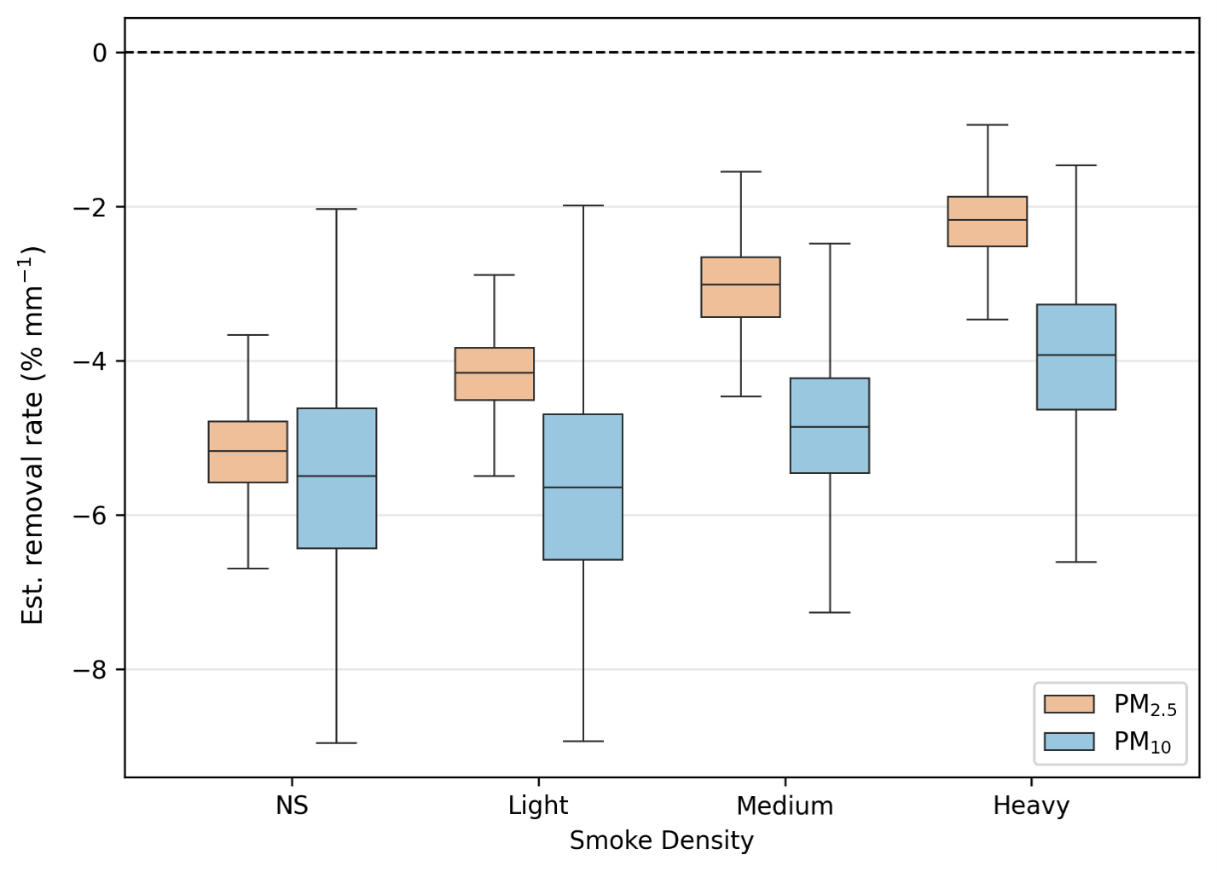
Estimated PM2.5 (N=3492) and PM10 (N=1552) removal rates across wildfire smoke density categories under full APCP distribution, with PM concentrations matched to values in the Heavy smoke category. Negative values indicating stronger removal.
Particle composition may be part of the answer. Wildfire smoke contains large amounts of carbon-rich organic material. Some smoke particles interact with water differently from particles produced by other pollution sources. Smoke can also affect cloud droplets themselves. Previous research suggests that large concentrations of smoke particles can produce more numerous but smaller cloud droplets, which can reduce the collision processes that help form larger droplets and precipitation. Our results cannot identify one single mechanism, but they show that the atmosphere during a wildfire-smoke episode does not respond to rainfall exactly like the atmosphere under ordinary conditions. This is relevant because wildfire smoke can raise particulate matter concentrations dramatically. In our data, particle pollution increased sharply as wildfire smoke became heavier. Median PM2.5 increased from 6.5 µg/m³ with no smoke to 16.9 µg/m³ during heavy smoke, while median PM10 increased from 15.9 to 42 µg/m³.
Virginia’s growing wildfire smoke risk
Virginia has experienced the effects of long-distance wildfire smoke several times in recent years. In June 2023, smoke from Canadian wildfires caused unusually poor air quality across the Commonwealth. More recently, Canadian wildfire smoke returned in July 2026, producing hazy skies and air-quality alerts across Virginia, including Code Red and Code Purple conditions in parts of Northern Virginia. Virginia's air quality is affected not only by local emissions but also by fires occurring hundreds of miles away. As emissions from traditional sources such as power plants and vehicles have declined, wildfire smoke has become a more important source of particulate pollution. Understanding how rainfall interacts with transported wildfire smoke can help improve air-quality forecasts and preparation for future smoke events. As the July 2026 episode showed, this is no longer only a concern for communities close to wildfires.
Conclusion
In conclusion, rainfall can remove particulate matter from the air, but the amount removed varies with particle size and rainfall intensity. Rain helps, but not equally. Heavier rainfall was generally associated with greater particle removal, while larger particles were removed more readily than the smaller particles. During wildfire smoke events, rainfall removed less particulate matter than at similar baseline concentrations without smoke.
This research was conducted by Dinesh Neupane, Dr. Viviana Maggioni, and Dr. Lucas Henneman in the Department of Civil, Environmental, and Infrastructure Engineering at George Mason University.
Authors

Dinesh Neupane
Dinesh is a Ph.D. student in the Department of Civil and Environmental Engineering

Dr. Lucas Henneman
Dr. Henneman is an Assistant Professor in the Sid and Reva Dewberry Department of Civil, Environmental, and Infrastructure Engineering at George Mason University