Could the winter’s biting cold lead to more biting insects? - What Virginia can expect this summer
Written by Dr. Amira Roess, Dr. Benjamin Cash, and Dr. Holly Gaff
After the bone chilling winter storm of February 2026, which brought ‘Snowcrete’ into our collective vocabulary, followed by a heating-to-air-conditioning-and-back-again journey through spring, many of us here on the east coast can’t wait for summer. Summer in Virginia brings many things to be grateful for: long sunny days filled with hiking, picnicking, and other favorite outdoor activities. However, people and pets are not the only creatures waiting to take advantage of the approaching summer warmth. Biting ‘bugs’, particularly ticks and mosquitoes, are also at their most active time of year. More than just itchy annoyances, ticks and mosquitoes can carry and transmit known diseases (formally known as vector-borne diseases) that can pose significant threats to human health.
Climate & vector-borne disease
Like all living creatures, mosquitoes and ticks are influenced by and respond to changes in their environment. The Virginia Climate Assessment, released late last year, surveyed decades of data and studies across the Commonwealth and found that summers have been gradually becoming hotter and wetter while winters have been trending milder. As summer extends its reach further into spring and fall, ticks and mosquitoes may be active for longer and bite more aggressively. More intense bursts of rainfall may also provide more breeding sites for mosquitoes, further increasing the risk.
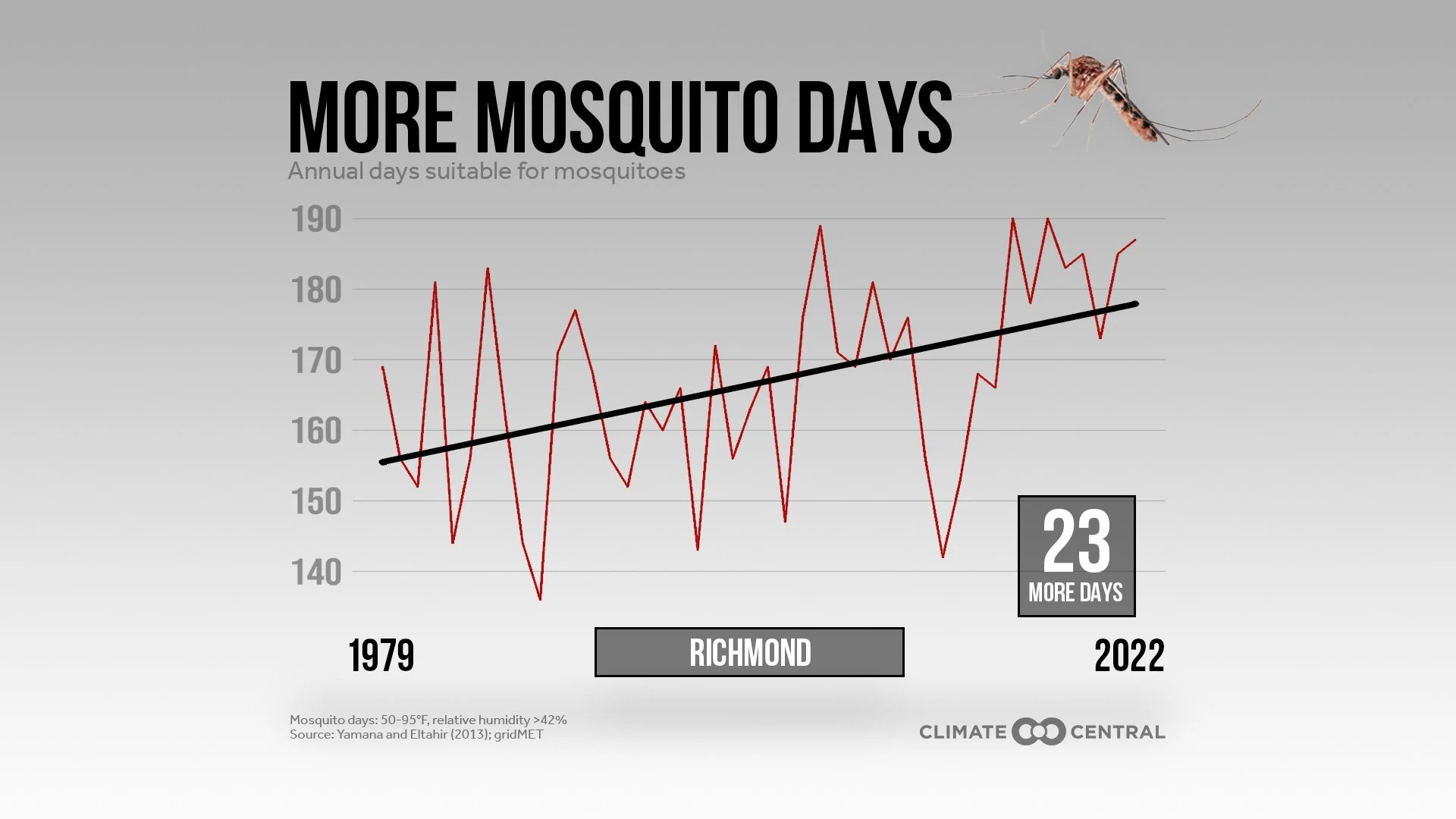
Climate conditions in Virginia are becoming increasing suitable for mosquitoes. Source: Climate Central
What can we expect this summer?
The 2025-2026 winter was not particularly mild, as Snowcrete hit the region with snow, ice, and frigid temperatures for weeks. You would think that after such a harsh winter storm, we would not have to worry about mosquitoes and ticks. However, this summer may bring with it an increased risk of tick and mosquito bites.
Experiments in the lab of entomologist Dr. Holly Gaff at Old Dominion University showed that ticks may be biting more aggressively in the coming months. During extreme winter conditions, ticks may survive by finding pockets of air to hide in for up to one month in freezing temperatures. Meanwhile, those same winter conditions can kill off many of their natural hosts (think field mice and deer). This means that ticks may be more frantically looking for humans and their pets rather than their usual victims this summer.
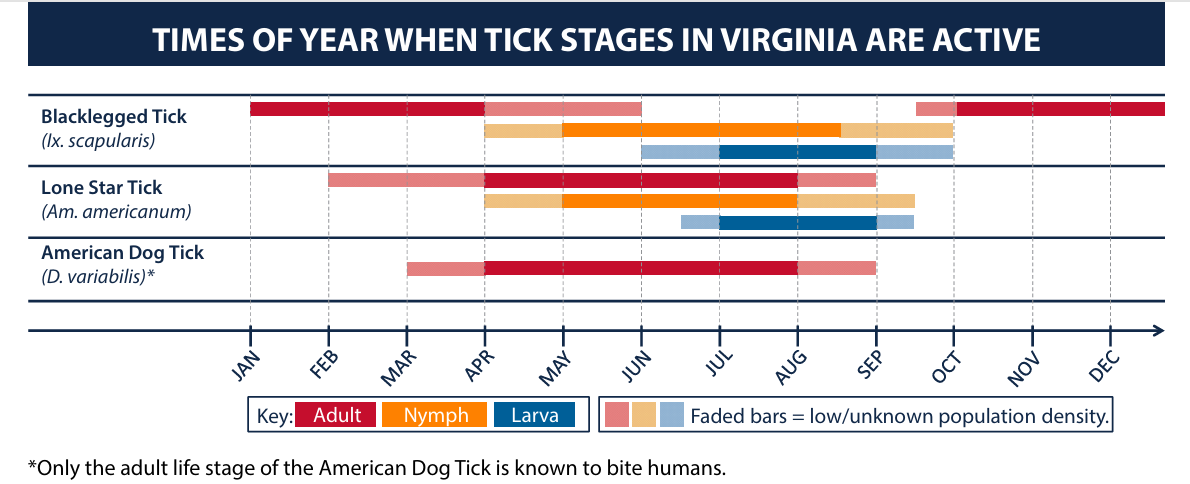
Times of year when tick stages in Virginia are active. Source: Virginia Department of Health
Tick and mosquito surveillance in Virginia
While we have very limited surveillance activities for vector-borne diseases in the United States, we do know that health care providers around the country are seeing an increase in vector-borne disease cases. In the Virginia region, reported Lyme cases have been steadily increasing, despite the limited surveillance, to the point where health care providers routinely prescribe antibiotics now for those with a history of tick bites. Fortunately, there is now a Lyme vaccine for dogs (but no such luck for humans...yet!). Meanwhile, mosquitoes in the region have been found to carry West Nile Virus and, a bit to our south, formerly ‘tropical’ mosquito-borne illnesses such as dengue fever and chikungunya are slowly creeping north.
Protection against vector-borne disease
Fortunately, there are steps you can take to protect yourself and your family.
Insect Repellent – The best way to protect yourself from diseases transmitted by tick and mosquito bites is to avoid being bitten at all! There are a wide variety of EPA-tested and registered insect repellents and repellent-treated clothing that can help reduce the chances of being bitten.
Eliminate standing water on your property – Mosquitoes breed in standing water, in some cases in as little as a bottle cap! Mosquitoes are also not great long-distance flyers, and don’t tend to stray too far from their breeding sites. Simple, non-toxic mosquito traps like the so-called “Bucket of Doom” can also help keep mosquito numbers to more manageable levels.
Wear protective clothing – Clothing doesn’t need to be treated with repellents to help protect you from ticks and mosquitoes. Light colored clothing with long sleeves and pants legs tucked into socks can help keep them away from your skin and make them easier to spot.
Seek health care-if you find a tick on yourself or a loved one you can follow recommendations to carefully remove it, preserve it and take it to your doctor.
Common vector-borne diseases in Virginia
Some of the vector-borne diseases of greatest concern for Virginians are:
Tick-borne disease – The most common and severe forms of vector-borne disease in Virginia are transmitted by the bite of infected ticks from a variety of species.
Lyme Disease - By far the most common tick-borne disease in Virginia, numbers have been steadily on the rise for years. Caused by the bacteria Borrelia burgdorferi and transmitted by the bite of infected Blacklegged (deer) ticks, most infections are caused by bites from tiny nymphs. Some (but not all!) people infected will see a red “bull’s-eye” rash around the site of the bite, and the rash can be difficult to see for persons of color. Fortunately, Lyme disease responds well to antibiotics when identified and treated early for the majority of people.
Ehrlichiosis – The second most common tick-borne disease to affect persons in Virginia. This disease is caused by another set of bacteria (Ehrlichia chaffeensis and Ehrlichia ewingii) and is transmitted by the Lone Star tick. Because Ehrlichiosis can cause severe illness if left untreated, early treatment with antibiotics is important.
Alpha Gal Syndrome (AGS) – A relative newcomer to this list, AGS isn’t a disease but a potentially life-threatening allergic reaction that people can develop to certain types of meat and products made from mammals, usually after being bitten by a Lone Star tick. Symptoms can range from mild to severe and may include hives, gastrointestinal issues, and anaphylaxis. The condition can be very serious, making awareness crucial for those living in places with a lot of ticks.
Anaplasmosis- The incidence of Anaplasmosis (from the bacteria Anaplasma phagocytophilum) in Virginia has been increasing in recent years. There has been an average of 13 cases of reported per year, and 18 cases on average if you include those that go undetermined due to uncertainty in test results.
Babesiosis - This is an emerging disease in VA, with a steady increase in cases in the last 10 years. Transmitted by the same ticks that spread Lyme disease, most people infected with babesiosis will either have flu-like symptoms or none at all. But severe cases can lead to life-threatening complications such as anemia, particularly for people with weakened immune systems. This is caused by a protozoan, Babesia microti, and so is more like malaria.
Mosquito-borne disease -While Virginia generally sees far less incidence of mosquito-transmitted illnesses than tick-borne, taking steps to protect you and your family from mosquito bites can still potentially save you from more than just a set of itchy welts.
West Nile Virus - West Nile virus can cause flu-like symptoms and in severe cases, neurological disease. In the late 1990s, West Nile virus emerged as a serious threat in the Northeast with notable outbreaks in New York City. At the time large numbers of birds died due to West Nile virus. Human cases have been found throughout the country with the highest number reported in 2003. Since then, the number of cases has decreased significantly. Scientists are studying why that is and how to predict outbreaks before they even start.
As we look ahead to summer, the key message is not to avoid the outdoors but to enjoy it and engage with it thoughtfully. You can take simple, practical steps like using insect repellent, wearing protective clothing, eliminating standing water, and checking for ticks to reduce risk of disease while still enjoying everything the season has to offer. In a world where warmer temperatures and shifting conditions are extending the reach of ticks and mosquitoes, small everyday actions can make a real difference, helping to protect not only your own health but also that of our communities.
Authors

Dr. Amira Roess
Dr. Amira Roess is an epidemiologist and professor of global health at George Mason University. Dr. Roess is an expert on emerging zoonotic (animal to human) infectious diseases and their risk factors. She has led the Pew Policy Commission on Industrial Food Animal Production as the science director, served as a CDC epidemic intelligence service officer, and provided guidance for preparedness and response to H5N1 bird flu in 2006. Roess was a leading source during the COVID-19 pandemic and is an in-demand public health consultant.

Dr. Benjamin Cash
Dr. Benjamin Cash is a climate scientist and research professor in the Department of Atmospheric, Oceanic, and Earth Sciences at George Mason University. He studies the predictable and unpredictable components of climate variability, particularly in relation to phenomena such as droughts, floods, and large-scale atmospheric dynamics. Dr. Cash is an expert on prediction and predictability of the climate system and the influence of climate on infectious disease.

Dr. Holly Gaff
Dr. Holly Gaff is a professor and chair of Biological Sciences at Old Dominion University and a leading researcher in the ecology of ticks and tick-borne diseases. Her work integrates field biology, ecology, and computational approaches, and she leads the ODU Tick Research Team, which conducts long-term surveillance and mapping of tick populations in Virginia to better understand their spread and associated health risks. Through this interdisciplinary research, Dr. Gaff has contributed extensively to the study of vector-borne diseases and public health, publishing numerous peer-reviewed articles and collaborating with agencies such as the NIH, CDC, and USDA.