From farm to table - The climate signal showing up in our food systems
Written by Dr. MB (Marybeth) Mitcham
Extreme heat is among the most impactful and rapidly intensifying manifestations of a warming climate, with widespread increases in the frequency, intensity, and duration of heat extremes. Because food systems are tightly interconnected, incorporating human and natural components, changes in the frequency and duration of extreme heat events pose risks to food systems that extend well beyond crop yields, affecting livestock, supply chains, food access, and human labor.
Episodes of extreme heat, especially hot-dry extremes, where dry soil amplifies surface temperatures can negatively impact food systems which are especially sensitive to short yet intense heat. Crop responses to temperature are especially vulnerable to extreme temperature fluctuations. While moderate warming can accelerate plant development, exposure to temperatures above the critical threshold, particularly during flowering and grain-filling stages, can result in sharp yield losses due to pollen sterility and reduced grain protein content. Large-scale analyses show that yields decline sharply once crops exceed these physiological limits, even when the average temperatures of the growing season remain overall ideal.
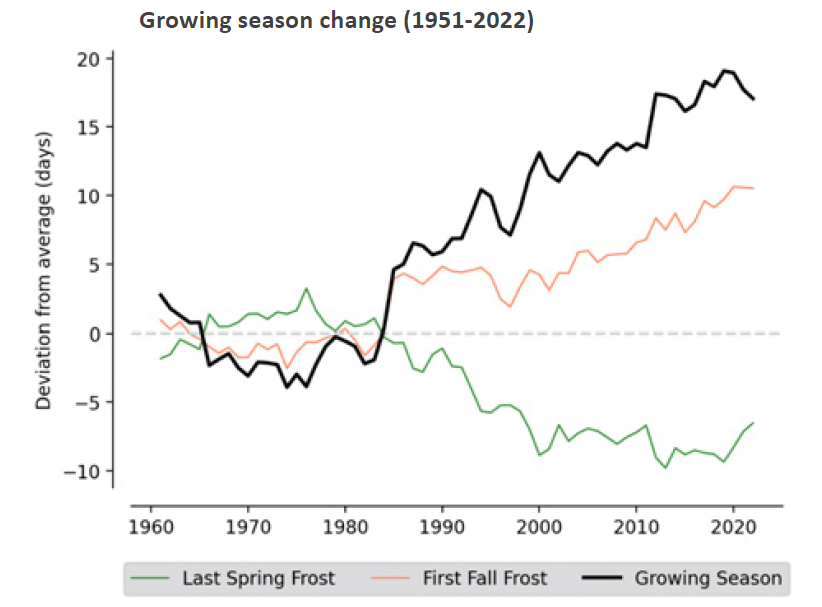
Deviations in average dates of last Spring frost, first Fall frost, and growing season. Figure source: The First Virginia Climate Assessment; Data source: NOAA nClimGrid-daily
Global analyses suggest that climate trends, especially increased episodes of extreme heat, have already reduced grain yields in recent years. Although elevated atmospheric CO₂ can increase photosynthesis and water-use efficiency, the findings indicate that it does little to offset yield losses from short, intense heat extremes. Livestock systems are similarly constrained by heat stress. During extreme heat, livestock experience reduced feed intake, milk production, fertility, and survival, particularly in tropical regions and in agricultural environments designed for mass production. Future climate projections under high-warming scenarios suggest that increased extreme heat events in some regions may negatively impact safe livestock production.
Extreme heat also obstructs the efficiency of human labor in agricultural systems, an often-overlooked pathway linking climate extremes to food system outcomes. At high temperatures and high humidity, outdoor agricultural work becomes dangerous, which compounds production losses and increases costs. However, although extreme heat's effects on human well-being and physiological safety are among its negative impacts, its effects extend beyond this human role to agricultural production. High temperatures increase food spoilage rates, heighten food safety risks, and increase energy demand for cooling during storage, processing, and transport. These effects are unevenly distributed, with infrastructure and energy constraints exacerbating food safety risks in low-income settings. On larger scales, widespread heat extremes across multiple agricultural regions can disrupt global supply chains, contributing to higher food costs for consumers. Systems-based analyses increasingly point to extreme heat as a driver of systemic food loss even when global production losses appear modest.
Exposure to extreme heat and its impacts on the food system are also unequal. Small-scale farmers, low-income urban populations, and regions with limited adaptive capacity face disproportionate risks, with heat extremes directly linked to food insecurity and undernutrition.
Adaptation options, such as heat-tolerant crop varieties, altered planting dates, and microclimate management, can reduce the negative impacts of extreme heat. However, they do have their limits. Modeling studies show that adaptation benefits diminish rapidly at higher warming levels, underscoring the importance of mitigation, rather than focusing on food systems adaptation efforts.
Extreme heat also impacts fishing and hunting, food systems pathways that are often less visible in climate impact assessments but are critical components of human nutrition and livelihoods. Rising air and water temperatures alter the distribution, abundance, and phenology of fish and wildlife, pushing many species beyond their temperature tolerances and reshaping ecosystems as populations move to cooler regions. In aquatic systems, marine and freshwater heatwaves reduce dissolved oxygen levels, increase disease prevalence, and trigger mass mortality events. Extreme heat also intensifies stratification in lakes and coastal waters, compounding the risk of hypoxia and reducing habitat availability for cold-water species. For land-based hunting, heat extremes affect wildlife physiology, reproduction, and migration, and increase mortality from disease and drought. Increased episodes of extreme heat can reduce game abundance and alter seasonal availability of wild game and birds, undermining subsistence hunting and harming cultural food systems, particularly in Indigenous and rural communities.


Reports such as the Virginia Climate Assessment show that anthropogenic warming has already increased the likelihood of extreme heat events affecting major agricultural regions in Virginia, transforming historically rare conditions into recurring risks that are projected to intensify in the future. In response, it is imperative to continue research on extreme heat and compound events to better understand food system shocks from climate drivers, and to consider labor, nutrition, and equity impacts when integrating solutions. Addressing these gaps is essential for understanding the true boundaries of food system resilience in a warming world, and ensuring that all life, within Virginia’s ecosphere and beyond, have access to food for years to come.
Author

Dr. MB (Marybeth) Mitcham
Dr. Mitcham is an Assistant Professor and Director of the online MPH Program in the Department of Global and Community Health at George Mason University